
The photo above is of Auntie Florry, taken in her back garden in College Road, this photo is how most of us will remember her. Probably taken in the 1960s.
This memoir was written by our Great Aunt Florenz Pook, it recently came to light (2022) via a distant Sanderson relation. Florenz Emma Pook was my Grandmother’s sister Eva May Pook nee Butler. Auntie Florry as she was affectionately known to all of her many great nieces and great nephews & other close relations. She left quite a substantial written record of her life, most of which were left to my mother Muriel Dorothy Butler, nee Barry, her niece. Mum very kindly left Auntie’s written record of her life to me. In due course this written record of Auntie Florry’s life will be recorded here. I have worked out from Aunties recounting of this incident that the events in the memoir below took place in 1888! Auntie would have been 3 years old when this incident occurred.


I will attempt to list Auntie Florry’s memoirs, reminiscences chronologically. (apart from the one above)
She typed them up many years ago and bequeathed them to my mother who in turn bequeathed them to me.
As far as we know this is the first of Auntie Florrys typed/written memoirs, it is titled “Aden, Arabia, 1885”


The Title of this Memoir is “1888 The Colonels Flowers” I believe this is the first Memoir that she wrote entirely from her own Memories!


This Memoir is titled Jersey C.I. 1880-1891


Auntie Florry belonged to her Grandfather’s and Father’s Regimental Association and was a regular contributor, featured below are several front covers of the publication and copies of several of her contributions to the Regimental Magazine.

Cheenie was our Grandmother, Eva May Pook, nee Butler.


“Ireland 1891” is the title of this contribution of hers to The Regimental Magazine.


Another Cover of The Regimental Magazine

Birr or Parsonstown – Ireland 1891 – 92


Pook family portrait probably taken in the mid 1890s, probably taken in the Channel Islands
L to R – Eva May Pook, (Our Grandmother) Florenz Emma Pook, John Pook, (Our Gt Grandfather), Charles Pook, (Gt Uncle) seated on his mother’s lap (probably) & Annie Elizabeth Pook, nee Sanderson. (Gt Grandmother)


Auntie Florry was awarded the Book above, “Ben Hur” for Good Conduct presumably from the school she was attending, Christmas 1897 when she was 13 years old.
Not sure if this is in the correct order in Auntie’s chronology, but as far as we know she did not record (or it has not yet come to light!) any of her memoirs of her life between 1892 and about 1908. Of course it is quite possible that nothing eventful happened in Auntie’s life between 1892 and 1908 apart from her attending school/colleges and perhaps she thought there wasn’t anything worth recording, but knowing Auntie there probably was! So what and where ?!
The following 1901 Census Return form shows that the Pook family were living in Fleetwood Lancashire


At the age of 15 Auntie spent a year at the L.L.C. Teacher Training College and then at the age of 16 she began teaching, in her words, “the hard way”. She spent several years teaching in the UK until she secured a place as a teacher in Jersey in the Channel Islands. The Pook family were stationed in Jersey for several years when their father was stationed there with his regiment the South Lancs from 1888 to 1891 so it was a place she knew and loved.
The pages reproduced below are from a notebook that Auntie Florry used to record a trip that she made in 1909. Our oldest brother Terry Barry has had this Notebook in his possession until recently, 2024! He has kindly gifted it to me to share with you all. I have transcribed the contents of Auntie’s NoteBook at the end of these copies for ease of reading and understanding.


To make this note book easier to read and understand I have copied a complete transcription below.
F.E.Pook
St Andre
St Heliers
Jersey
8th April, 1909.
Adventures on the Continent
After many debates on whether we (Miss O’Reilly and F.E. Pook) should spend a few days in foreign climes we at last decided to risk our precious lives and see a little of, “La Belle France”. Yesterday, I was all day (and nearly all night) getting Miss O’R and myself ready. I think we got to bed somewhere about the time when yesterday and to – day met. Miss O’R had the alarm, and we both rose at 4.15 am this morning. I hurried and got dressed, then helped Miss O’R as I knew she would have a terrible dash for the 6.am boat if someone was not there to hurry her up. However she was very quick and we managed to be only 5 minutes late for breakfast, and also were in plenty of time for the boat. We stayed on deck for an hour when Miss O’R disappeared to her bunk, leaving me all alone, so I studied my phrase book, and was only interrupted once when an old gentleman made some observations to me about he being a bad sailor, and the weather being fine. Miss O’R reappeared as we neared St Malo, we landed, were searched at the customs and then went and had breakfast at a very nice shop.
Good Friday – >
We then wandered on until we came to a large Church, which we afterwards discovered to be the Cathedral. It is very beautiful in some ways the altars, etc, but the part of the Cathedral where the people sit is dirty and untidy. We stayed and saw the Bishop wash the feet of 12 men, after which we noticed that most part of the people left the Church and the ceremony was not nearly over. Suppose they first came for the sight seeing at least it looked like it. We then took the tram to the Institute Marine Rochebonne, where we secured lovely apartments.
We have communicating rooms, and the house is built right on the sea-shore and is some little distance from town, in fact we have the sea all to ourselves here. We left our luggage and walked back to St Malo resting for awhile at Casino. Sent some P.C’s then had lunch at an hotel after walking about the town for nearly an hour for a decent place, the café’s looked awful. We then visited the museum, not very large, but saw several interesting things. Cannonballs taken from the English part of the ship Jacques Cartier went to Canada in (a relic of which I stole nobody being about ) We also saw the shaving tackle of Chateaubriand. We then promenaded round the ramparts. There are many soldiers here. We then revisited the Cathedral, and went to the Chapel where there was Exposition. Sat down for a little we were so tired, and I was noticing the French people coming in and out. Two men I saw come in look at the altar and go straight out again.
The dogs come into the Church with their owners, who do not trouble a bit about them. We then had tea and returned to Rochebonne about 6.45pm, went on the sands, and roamed about with no hats on, having the whole place to ourselves. The tide was coming in and not a sound to be heard except the waves. Trotted off to our rooms and I wrote out this chronicle of our days doings and also some P. Cards home & India. Am going to sleep tonight almost in the open air as the windows here open like doors.
The sea makes a terrific noise.
——————————————–
9th April
Could not go to sleep last night for a long time until I got used to the noise of the waves, after which I slept soundly until Miss O’R called me at 7am. Dressed and had breakfast at 8am. We then got ready and started off for St Malo. No tram being in sight we walked and as we neared the town we saw a funeral of some man. It was so curious there were 9 soldiers and an officer, and the coffin was placed in a kind of hall with lights at the head, the walls being draped with white and the doorway in black & silver. We followed to the Church N.O. Auxiliatrice & then to the Cemetery. Very ugly wreaths made of black and white beads are used here. We then took the tram to St Servan, where after meandering about we at last hit upon the Cathedral which is much more beautiful than that of St Malo. Miss O’R and I had a good look round and saw the pulpit presented by Napoleon lll. Miss O’R then inquired in her best French of an old woman where the house of Jeanne Ingon was, and we then inspected the said edifice, which is a little house near the Cathedral. After another aus meander through various thoroughfares we passed the Arsenal and then came upon the Tour de Solidor. Inquired if we could see over it, and a French Madame got the key and brought us all over speaking all the time in French as she did not know English. But we understood and managed between us to find out as much information as possible. After that we again wandered about to find a restaurant to have lunch, found one at last, (and were taken in for about 80 centimes) so resolved to bargain next time like the French. We then took the train back and went to the Stations of the Cross at St Malo, where the people must have thought us Protestants as we sat down the whole time we were so tired, I nearly fell asleep. We then enquired (in French) our way to the Station and then after searching the time – tables in vain I at length enquired of a porter the trains to St Michel, and he spoke very decent French, because we understood every word. We then had to, (where we were again taken in) and then walked leisurely back to Rochebonne. Miss O’R making purchases on the way in two shops, and making good use of her French! Sat down by the wayside when we got out of the town and discussed our plans for tomorrow. Spent the rest of the evening in our rooms reading Wordsworth and Shelly and talking over the days adventures.
———————————————
10th April 1909
Slept well all night and rose at 7.30am this morning. Had breakfast then packed up our traps and departed from Rochebonne. Took the 10am tram to St Malo station where we deposited our baggage and made tracks for the tomb of Chateaubriand. Found where it was but could not reach it as tide was still in so in the meantime we went and saw two of the oldest houses St Malo also the house Lamennais, where we bought P.C.s, had dinner then returned to the sea where we found the tide out sufficiently to be able to reach the island on the top of which we visited the tomb of Chateaubriand. After that we hurried to the station to catch the 1.50 train for Mont St Michel, procured the tickets and we then procured seats in the train which was waiting there after asking two or three porters “C’est bien pour Mt St Michel” There were heaps of soldiers going by the same train. We saw the 3rd class carriages which are very bad, we travelled 2nd which were not nearly as nice as some of the 3rd in England. We arrived in Pontorson at 3 o’clock, where we took the tram to Mont St Michel across an immersed stretch of sand and marshy looking land. At the terminus was the greatest turn out for as soon as we descended we were simply besieged by men and woman pressing the merits of various hotels. I took a card or two & then noticed that we were being escorted by about a dozen of these people so I handed them back their cards, only keeping one on which was the name of the hotel Rev. Mother told us of. We then had an escort of two only and were met by the proprietor at the entrance to the Mont. After making arrangements in the exchequer line we took a room, rested for awhile then went out and had coffee etc, and then climbed up to the Abbey, had a look at the outside the door being locked. After another little wander we stumbled on the Musee where a guide took us over for 2 Francs and showed us various little kinds of peep shows and other things. We came out about 6.15pm, went to the P.O. where we bought stamps and posted cards & then returned to the hotel. I forgot to sa mention that after tea we visited the Church here, which is very small. It contains a silver altar with the statue of St Michel Crowned. There were many banners hung on the walls round the Church and at the entrance was a statue of Jeanne D’Arc.
There are several visitors here, the houses here are all huddled together, and the streets are all high, it is a very small place. A small island really.
——————————————–
11th April 1909
Easter Sunday
Last night about 12 midnight we were both awaked by men singing a French hymn about “Christ is Risen Alleluia” They kept it up for about 15 minutes, just outside the hotel!
Rose at 6.45am this morning went to 7.30am Mass at the church. There were many people in the Church in fact it was crowded. No communion was given during the Mass the people who decided to receive H .C. waited after mass was finished, there were about 6 only, and Easter Sunday too! and a Catholic country!! After Mass we returned to the hotel breakfasted and then climbed up to the Abbaye where we joined a party and saw all round the interiors of the Abbaye under a guide. It was very beautiful but as the guide spoke very quickly in French we did not understand much. We then descended from the abbey and inspected the shops which were awful bought some P.C’s and a little vase with a view of Mont St Michel painted on it for Eva. Returned to the hotel rested a little then dined in state on Mere Poulard’s Omelette and Ham etc. There were some very high class people there having lunch. We enjoyed the celebrated omelettes very much. We then departed to the tramway en route for Pontorson. In the carriage some French gentleman said, something to me in French, I told him I did not understand French, so he asked if I was German or English, then said he could not speak English. I think he was saying something about moving his coat from the part of the carriage where I was sitting. Arrived in Pontorson at 2.45pm. I procured tickets for Avranches and then we took the train at 3pm en route to Avranches where we arrived at 3.30pm. We marched straight off for the Hotel Bonneau, secured good room had coffee etc. then set off to explore the town which is situated on the top of a hill. We had to climb up a hilly road which had high banks which were very pretty covered with primroses celandines violets and the blossoms of strawberries (wild). We inquired our way to the Eglise de Notre Dame des champs, found it entered and went all over it. Lovely stained glass windows, towers? not finished, lovely high altar. Then we went in the Jardin des Plants from where we had an excellent view of the Bay of St Michael with Mont St Michel in the centre. In trying to find a shorter way back we stumbled on another Church which we visited and then nearly lost ourselves but then by dint of asking about half –a-dozen people we at last arrived back at the Hotel after taking about three times as long a way to return. Don’t think we will try and find short cuts again in a strange country. Went straight to our room where we had supper, talked over the days expedition and made plans for to – morrow.
We are well able to ask for what we want at hotels, and to ask our way about the country now, we don’t think of speaking English to the people here even when we think they look English. This hotel is very good near the station.
———————————
12th April.
Got up at 7.30am, dressed and had breakfast, then set out for the sights of Avranches armed with a guide book and a Phrase Book. Found out the Bishops Garden, Hotel de Ville bought some P.C’s in a shop where we inquired the way for the stone on which Henry II did penance. Had to ask again as could not find it and in the end followed 3 men up a hill who looked like tourists and were successful in finding the stone. Stepped over the chain enclosing said sacred spot and touched the stone! Miss O’Reilly knelt down on it after looking round to see if anyone saw her was looking. We then trotted off to visit the Church of St Gervais which we found easily entered and inspected the whole interior. Had found out before entering that if we asked we could see the skull of St Aubert the founder of Mont St Michel, so after we had seen the whole church, read the Ex Voto, the Annals on the latter of which was mentioned that Charlemagne heard Mass in that Church before going to Mt St Michel. Miss O’Reilly told me to ask someone if we could see the relic of St Aubert I asked an old woman she did not understand me but her husband did, and told me had he knew nothing about it so as Miss O’Reilly had just got a fit of the giggles I had to put on a serious face and asked a man who looked as if he had something to do with the Church. He understood my French alright and as it happened he was just the right one to ask as he brought us into the sacristy took out the keys from his pocket then unlocked a huge safe where to our astonished and awed view we were shown a great golden casket in which was a skull with a hole in the back of it. The man told us something about the hole but we could not understand, he must have thought us heathens, as we simply stood and stared. We were so dumbfounded at our cheek. At last we said merci and marched off. There was not much we had not seen for the want of asking, as we saw everything mentioned in the three guide books we had. After that we went back to the hotel had dinner, and then packed up once more. Caught the 2pm train for Granville, jumped into a 2nd Class carriage, have to travel 2nd here and arrived safely at Foligny where we the train waited such a time that Miss O’Reilly said she thought we ought to change, but I said no, if so the porter would call out “Changez ici pour Granville”. So we went on in the train, when after we had passed a couple of Stations and we knew we ought to be near Granville, Miss O’ R remarked
that no sea was anywhere in sight, began to doubt if we were wrong, so the next station we stopped at we consulted the map in the guide book and found we were on our way to Cherbourg, descended in haste and I made straight for the ticket collector and explained in my very best French the hole we were in. He laughed at us and told us there was another train back to Foligny in 30 mins.
The station at which we got stranded was Cerences. Whilst we waited we looked in the Guide book to see if there was anything worth seeing there, but the place was not mentioned. At 3.30pm made sure and asked two porters “C’est bien pour Foligny” jumped in the train and started off once more. Arrived in Foligny at 4pm descended from train, and then caught another for Granville which we duly reached at 5.30pm, found out the Hotel des Voyageurs deposited our baggage, secured a room and set out for the Church here. Had to climb a hill and then reached the Church but did not like it, something about it gave me the shivers, perhaps because there was a coffin there in the sanctuary and the whole church was decorated with black banners. Soon came out again. Had a good view of the harbour and then found out the ship we have to take to morrow en route for Jersey. Had coffee etc in a tea shop and returned to Hotel. Not much in Granville to see don’t like the place at all.
—————————–
And that was Aunties abrupt but interesting end to her Adventures on the Continent”For ease of comprehension and understanding I have tried to transcribe word for word this written account of Auntie Florry’s, “Adventures on the Continent” Some words were easier than others and a few I have had to guess at, but I hope essentially we have an accurate account that we can understand, read & enjoy, of her “Adventures on the Continent”! , in 2024 One Hundred and Fifteen Years after she wrote them down!
The short insert that I have copied below refers to when Auntie Florry began her teaching career in about 1902, she actually wrote these words in 1949 just as she retired from teaching.

“School Life In Jersey” almost certainly took place around 1910/1911, or maybe earlier? There is a Channel Island Census Return for Auntie dated 1911. This Census was taken on Sunday 2nd April 1911. Not sure how long Auntie Florry spent in the Channel Islands but she (according to her memoirs) was back in the UK during the WW1 years 1914-1918. WAAF?


Auntie Florry appears on this 1911 Census Return featured below from Jersey in the Channel Islands, and according to this Census she was a Head Teacher in the Parish of St Mary.

Auntie Florry was back in the UK for the start of the Academic year 1911 as she was studying again at a London Teaching College for one year, ending her study there in 1912 . Below is a copy of a letter from the Principal of the college, possibly a Reference letter.

Auntie Florry was back in the UK for the start of the Academic year 1911 as she was studying again at a London Teaching College for one year, ending her study there in 1912 . Below is a copy of her Diploma that she obtained from The College of Preceptors.


Great Grandparents Pook, and Grandmother Pook & family, picture taken about 1913.
L to R – seated- Great Grandmother Annie Elizabeth Pook (nee Sanderson) b 27 July 1864 – d 07 Feb 1938. Grandmother Eva May Pook b 1887 – d 05 Nov 1965, Great Aunt Dorothy Helena Pook b 1900 – d 25 Dec 1927, Great Aunt Florenz Emma Pook b 27 Jul 1885 – d 13 Sep 1974, Great Grandfather John Pook b 1854 – d 05 Nov 1932
The image below is a copy of the 1921 Census Return. Auntie Florry at the age of 35 was still living with her parents at 43 South Dean Gardens, Wimbledon SW19. She was a School Teacher working at the London County Council School, Southfield, Merton St, Southfield. We believe she was looking after her elderly parents as well as working full time. Her brother William aged 25 is also living with them and is working as a Civil Servant in London. Prior to WW1 he worked as a Civil Servant & also served as a Territorial Cadet part time until War broke out when he became a Full time soldier for the duration of WW1. Mabel E Wrightson, the visitor on Census night was to become William Pook’s wife in 1922.


Auntie Florry does not mention her mode of transport home when she wrote up her “Through The Battlefields of N. France (1914-1918 war) “ She does not state exactly what year, she and her friend Alice travelled to France, but intimates 1920-21. However, she does indicate that they “set forth on a day at the end of July”. She states at the end of her piece on N. France, “We ended our visits to the battlefields and returned to Paris where we spent a week “seeing the sights” before returning to London”. I have roughly calculated that they spent 2-3 weeks in France.
But did they then travel to Marseilles, and then embark on the “Matiana” before returning to London, the dates do not match exactly, but Auntie Florry did not stipulate in her writing exactly what year she and Alice travelled to France. Having said all that, their time spent in France during July/ August does match up as the “Matiana” sailed to London, arriving on the 26th August 1923.
The facts of the matter are as follows. On 26th August 1923 the “Matiana” of the “British India Steam Company” arrived in the port of London. She had sailed from Calcutta, India and had called in at Madras, Marseilles, Gibraltar, Plymouth, and finally London.
The Passenger lists for the “Matiana” included Alice and Mary Malkin (friends/ teacher colleagues of Florenz Pook (teacher) who was also on the passenger list. All three of them embarked from Marseilles. Alice and Mary Malkin, landed at Plymouth, whereas Florenz Pook landed at the port of London. Her 2 friends lived at Stoke-on-Trent, Florenz Pook’s address on the passenger list, states her address as 43 Southdean Gdns, Wimbledon Pk Rd, London, SW 19.
Perhaps I am reading too much into Auntie’s travels and dates, and maybe I can or will be corrected. However, the distance by rail from Paris to London is about 280 miles. The distance from Paris to Marseilles by rail is about 480 miles, and from Marseilles through the straits of Gibraltar to the Port of London is another 2,010 miles ( nautical). If the “Matiana”travelled at 10 knots it would take 8 days and 9 hours sailing to reach the port of London from Marseilles. Quite a long trip home, but it probably was a very pleasant cruise home. I am no mathematician but the sums speak for themselves. Or maybe she made another trip to France and did not write it up for us. Or maybe the young women just fancied a cruise home on the “Matiana”. Or maybe…………………….???
Also she does not mention Marseilles in her piece, and if it was another trip she made to France why did she not write up her experience? Questions, questions, questions?
Below is a copy of the Passenger list that I mentioned above.

A Post card, Post Marked 17 April 1922 from Auntie Florry written in Italian to her younger brother William (Uncle Binkie) who was still living at home with his parents at 43 Southdean Gardens, Wimbeldon Pk Rd, London. SW 10. We can only presume that Auntie Florry was on holiday in Italy at this time. Holiday Passenger list !!!??? who with ??? no record found as yet on Passenger lists – Jersey Passenger lists Trains?

My translation or the gist of Auntie Florry’s written Italian to her 28 year old brother is below. I hope my translation (literal) via Google is reasonably accurate, I also think that Auntie may have written this postcard in Italian and French, she was multi-lingual!
We love the Music Half the evening At this hotel
————————–
My dearest brother we are happy here in the hotel
and it’s a great and very beautiful place. We love the Bourgeois gardens.
I speak Italian to all the soldiers for me as director. This picture is of Swiss Guards of the Pope. Good Wishes
Florenz
This piece below was written for the Regimental Magazine by either Auntie Florry or maybe her father (Our Great Grandfather) who features in this article “Our Veterans” interestingly there is no mention of William Pook our Great Grandfathers other son who also served as a front line soldier during WW1 in the Machine Gun Corps. It is interesting to note that our Great Grandfather’s other son Charles Pook, Royal Engineers who was awarded a DCM during WW1 for bravery was included in this piece. This piece was probably written & published in the 1920’s.


Auntie Florry was 43 when she travelled to Rome & Paris in 1928.


My first visit to U.S.A. 1929


Auntntie Florry appears to have been in the habit of duplicating the notes/records of some of her trips. The trips she made to the USA are a case in point, below is a copy of another record she made of her trip to the USA IN 1929!
The pages reproduced below are from a note book that Auntie Florry used to record a trip that she made to the USA in 1929. Our oldest brother Terry Barry has had this Note Book in his possession until recently, 2024! He has kindly gifted it to me to share with you all. I have transcribed the contents of Auntie’s Note Book at the end of these copies for ease of reading and understanding.


Notes on visit to United States August 1929
Florenz. E. Pook FEP
31.7.29
Arrived N.Y. one of the first off the boat, carted off to Customs office by negro to deliver up brandy, many apologies from customs offices.
Couldn’t see Margot anywhere so stood on top of baggage. M spotted me then we had to wait for Mr M who was searching the boat for me. Took ferry over Hudson then train then taxi. Great place for shoe cleaning. Man on ferry walking round for shoes to clean 1.5c. Had lunch here rested & played anagrams in the evening.
1-8-29
Went out sight seeing with M her son & friend took subway to shopping centre N York (Department Stores). Had lunch at Automat . Great place put 1 nickel in slot for milk. Hold glass under tap.
Put 2 nickels (5d) for pie,
“ “ “ “ , sandwiches.
Put all on a tray, find place at table. Everything scrupulously clean.
Macey (department stores) latest innovation, all one floor cooled with cooled air. Double doors to street. Took bus to ride through 5th Avenue to Riverside, All avenues ride N.S of City, streets run E.W.
Traffic Green lights show all clear for traffic in 5th Avenue & Red lights all clear for traffic in street to cross 5th Avenue so whole of traffic is automatically stopped along 5th Avenue whole length then all streets entering.
Passed St Patricks Cathedral & all millionaires’ mansions overlooking Central Park. N. York built on Rocks – many seen in park, same height, also seen in foundation of re-building.
Visited General Ulysses Grant’s Tomb on banks of river. Similar to Napoleon’s but wife’s tomb at side.
Flags of American war found their mauve coloured glass in windows. Another big monument to soldiers & sailors of American War on banks of Hudson.
Returned by bus under Holland tunnel (NY to Jersey City) Two tracks, slow track & fast track former latter aligned to keep up requisite speed forbidden to overtake. Air circulated by huge ventilators seen in harbour 1 each end of tunnel. Solely for vehicles, policeman stationed at intervals.
Had iced lemonade at Refreshment bar all of us sat in high stools at bar. (Similar to Italian bars)
Customary in hot weather to shut up same side street & turn a fire hose making small fountain in centre of road for poor children to play with, clad in bathing knickers.
Interesting Franciscan Church in centre N.Y small garden at back, fountain in centre gold-fish in pool. Models of many animals grouped round plot of grass.
Niche showing St Francis speaking to birds & animals.
Electric fans in churches & subways.
Shoe Shine Parlours. Great street here no one cleans own shoes.
1. shoes 2. High shoes (boots)
3. Boots are knee length.
Told that ladies here are provided with “Land Shields” when shoes are being cleaned
(No distractions to cleaners)
Played Anagrams again with Margot & her hubby Mr & Mrs Mac Sweeney?
2.8.29
Went to visit Statue of Liberty. Took ferry boat over. Colossus Statue can go by winding stairs to crown of head. We didn’t, only took lift as far as foot of statue. Formerly people were allowed up the arm also, now considered to dangerous. Came back & went partly under Aquarium Similar to one at Zoo.
Then went on to Mr M’s offices National Catholic Welfare Conference, excellent & thorough work & care for Catholic emigrants.
Met Mr Smith. Anagram & Rummy
3-8-29
Visited Natural History Museum building not so imposing as London but arrangements of exhibits finer.
Animals, birds and other life specimens (butterflies) shown in glass cases in natural environment. Splendid collection of Indian life. Wigwams (actual) with figures of Indians seated inside fire and & furnishings complete.
4.8.29 Visit to Ellis Island (Special) Got up 5.30 am. Took special ferry for Ellis Island (solely for employees social workers) Introduction to Monsignor Formica large airy buildings kept exceptionally clean. White tiles all over special room for all branches of social workers (about 20 different branches) religion & otherwise. Went to a large hall where we heard mass for immigrants persons (undesirables for deportation segregated from others. Had breakfast in employees restaurant. (Bird flying about inside hall. Mr Mac Said it was detained something arranged its passport!) Saw dining hall washed over after every meal.
Long tables chairs
Paper table cloths
Paper serviettes
Paper teaspoon )
2 large plates = attractive china ) each
1 large mug ) person
Spoon knife fork )
Read menu for day plenty of milk served for women & children. Very good menu. Kitchen kept airy, fresh sanitary.
Older buildings on island consist of isolation hospital & ordinary hospital.
Not the numbers there at present as formerly when all 3rd class entrants to U.S.A. were detained.
8.30pm. 4.8.29
Had fine view of Zeppelin from Europe (Graf) sailing up Hudson circled round N.Y. & made for Aerodrome. Searchlights & aeroplanes accompanying.
6.8.29
Bought hat Savilles In 5 mins. Went to see Pennsylvania & an immense station clean cool fresh – marble like flooring, tiled walls, no open space direct onto platform. Descend through indicated gate to desired train. No trains seen from booking hall.
Trans continental aeroplane in view. Platforms called tracks. Went in to see G.P.O. another immense structure. Saw Grand Central Stn more stupendous than Pennsylvania. Ceiling in booking hall like sky-with various mythological animals at sides. Exhibition In gallery above booking hall of first engines & coaches (1830) Also an exposition ”Bremen” aeroplane that crossed atlantic 1927.
Shuttle train runs from Times Square to Grand Central, backwards & forwards only.
6.8.29
Woolworths building 57 stories. Local & express elevators, many of them consists of offices. Entrance hall very beautiful, green & gold mosaic domed ceiling. Noted currents of air (very strong at times through streets) due to great height of buildings.
Went over noted luxury shop (Wanamakers) situated two sides of street, bridges across street connect each floor of two buildings. Saw court Council House (Mayor of N.Y.) Armistice Day Last Post sounded from steps (Flag) (Taps name given here)
7.8.29.
Went to Paramount Picture House. New (about 2 yrs) Large Magnificent entrance hall. Candelabra (glass) electric. Tapestried walls, palatial place. Large antique French furniture, cost of entry 65c any part of house. Cost of entry varies with time of day, cheap in morning (11am) dearest at night. & as Movable orchestra.
Organ disappears below stage level orchestra appears almost on level of stage. Illuminations of interior fairy like. Quite a variety performance between pictures. Dancing songs Transformation scenes, sketches (???) etc
8.8.29
Went to Coney Island about 1 ½ hrs from here. Great amusement centre. Big wheel, variety of side shows, sandy shore, variety of bathing pools Chinese, Jews, seem to predominate.
Coney Isle in Brooklyn.
9.8.29
Margot Tom & I left here 11pm en route for Washington (some 200 miles). Went to Pennsylvania Station for Excursion train Rly time night time. Fare for excursion 5$ ordinary fare (sleepers) 20$ seats reversible similar to modern buses at home. Green velvet covered not to close together. Fast trains only two stops. Reached Baltimore in 4 hours, train mostly crowded with negroes, a very modernised negro, dressed in latest fashions well behaved. Attendants up & down train all the time with ices – P.Cards-sandwiches-drinks, some shouting at top of voice, not inducive to sleep. Many nigs got out at Baltimore.
Reached Washington at 4am just as sun was rising at back of station which is an imposing & beautiful building. No summer time here G.P.O. next to station another grand building. Capitol exactly opposite. Rest rooms models of modern convenience – rocking chairs cubicles with couches for resting. Marble wash basins etc. Private Toilets spacious square in front of station. Went and had breakfast at Childs. Then walked down long avenue to find Church for Mass (Sunday) Heard (sleepily) 6am mass at St Patricks very warm in church. Walked back to Stn, then went with “Commodore” tourist agent man in nice comfy motor with 3 other people, now 7. 10am. (Early hours here) Had lovely drive through beautiful tree bordered avenues. City remarkably well planned. Go by numbers and letters. (N.W 4th Street) etc (South A Street.) Passed streets noted for great width & all tree lined open parks well kept no litter seen.
(“Honour system”selling papers take one put money in slot left to your honour to pay current charge.)
In Washington no overhead wires no factories, not included in U.S.A. no voting in this state, idea to keep opinion unbiased ! Passed through Embassy quarter of city, each one interesting, new English Embassy in process of erection in another quarter. Russian embassy boarded up. Passed home of Wilson’s widow. Went past White Lodge 2 or three times so had many views of famous place. Public entry & private entry. Went in through Zoological park plenty of space for animals, animals given good grazing ground. Birds have room to fly about.
Went into military cemetery where many of American notabilities in the American wars are interred.
Bennet the airman who died of pneumonia after attempt to rescue three airmen stranded on an island after flight over Atlantic also there. Hundreds of Americans fallen in World War interred there appears similar to French war cemeteries. Large amphitheatre in memory of where Presidents held memorial services. Tomb of unknown warrior in front of grand marble (circular) memorial to all fallen in all american wars. Tomb is perfectly plain of white marble – no inscription, continual sentry night and day, as sentry go. All this in elevated ground slightly above military cemeteries.
Wives of fallen in Great War also buried here.
Lincoln shot in theatre carried to base opposite. Saw these buildings.
Man ran down street escaped into Virginia free of charge.
Returned to Went on onward out of Washington into Virginia, Georgetown over long bridge. Here great division between coloured people & white. In station ticket office marked “coloured” “white”.
Motored through Georgetown noted old wooden houses of overlapping laths of wood. Came back into Washington, passed many pieces of statuary to noted people – Lincoln Garfield Generals, Admirals (1st of of Am Navy) saw place where Garfield was shot in leaving a station (site) also room where Lincoln was carried to die.
Left motor & took tram to Franciscan monastery where they have replicas of Catacombs (St Cecilia’s) also of Holy places in Holy land. Statue of St Francis with dove.
Very beautiful cloister , mysteries of Rosary inside. Extensive places beautifully kept, flowers – plants – trees.
Visited new shrine of Immaculate Conception close to American Catholic University. Crypt interior nearing completion, exterior untouched only red brick, 25 yrs ago was commenced.
Interior all marble from all parts of the World, roof beautiful tiles in varied patterns (copies of antiques!) Walls of altars mosaic work, much gilt mosaic. Marble flooring.
Returned to Washington City, had lunch at Childs, 11.30am. (chartered motor for afternoon). Embarked 12 midday after leaving Unknown Warriors Tomb, passed flying Grounds.
Margot, Tom and I had grand flight (in Aeroplane (seated 4 only) over Washington rose right above Washington memorial fine extensive view of Potomac river. Grand
Experience, fine day for flying, descent very gradual so did not get swing Sensation as in early flight 1919. Certificate presented to each for flight.
Afternoon motored to Lincoln memorial, stands high above great flight of steps. Colossus statue of Lincoln inside marble building – seated in arm chair very lifelike – appears looking straight ahead at Washington Memorial. Went on to great Obelisk to Washington 554 ft high. Went up in lift (9ft in 65 secs )
Small windows at top, great view of city.
Went on to the Smithsonian Museum. Here saw Lindbergh’s aeroplane ‘Spirit of St Louis’ in which he crossed Atlantic alone 1926.
Here ‘John Bull’ old engine built by G. Stevenson England 1830. Good show of ancient automobiles bicycles.
Went on past Capitol, domed roof in centre portion stands alone great flight of steps, two wings each side (Senate – House of Representatives ) no time to see over (White Building) next to library, magnificent building, grey marble columns, great hall , marble steps – iced cold water from drinking fountain, a poem to us on a hot day.
Some books kept in drawers. All citizens allowed to read, study. Joseph Pennel collections of etchings, lithographs some of Whistlers early sketches seen. Also original Declaration of Independence here kept under glass, protected by marble railings attendant always on guard.
Came back to station, had coffee & sandwich caught 4.30pm train for New York (5hrs). Arrived home midnight (summer time) Marvellous time. Had lovely views of hills of Maryland (Barbara Fritchie) from Library balcony.
In journey passed.
Pennsylvania named after William Penn (Quaker)
Philadelphia Saw Statue to Penn on top of Town Hall
Schuylkill River
Baltimore in Maryland
“ passed over Delaware River
Virginia
Washington not included in other states.
Saw meridian of 80 ̊ 78 white painted line in centre of roadway. Saw tidal basin in Washington (3ft below sea level) saves city from inundation. Japanese cherry trees planted along shores.
Numbered streets run one way. Lettered streets another. Avenues all radiate out from circles contains statue of some notability. Systems of plans of city designed by Frenchman.
13.8.29
Went in bus to see Broadway by night “Great White Way” Great sums spent yearly on electric signs and adverts. Aerials outlined in electric lights. Lights of various colours, scene of brilliance looking down Broadway. Went to picture house ‘Hippodrome’ seating accommodation for 5 or 6,000 people. Bus back to Jersey City through vehicular tunnel under Hudson, on main track, speed of 30 miles per hour to be maintained
14.8.29
China Town (Rival Tongs) Disturbance many police notices.
Italian Quarter Went into City Hall
St Andrews Church Printers Church (Mass 2.30 am each morning)
Broadway ?Bavery ? – Went to Stanley Cinema evening inevening J City.
15.8.29
Took elevated to Broadway ?Barey? passed poor quarter of city, many doss Houses. Visited Church of Perpetual Adoration. Monstrance is 8ft high. Chapel under main church, this system carried out in several churches. Went on to St Patricks Cathedral very fine stained glass is situated in 5th Avenue. All best glass shops found in this Avenue.
Went on to dinner at Childs, then home to anagrams & Rummy. Saw Flat iron building.
16.8.29
Went up to the top of Woolworths building 58 stories. Express to 39 then local to 54, then changed into smaller lift to 58. stupendous view of city, “Grand Canyon” looking down into street between skyscrapers.
Feast of assumption, crowds so great to hear Mass that outside St Peter’s in business quarters of city Police on duty (5 or 6) to regulate people entering & leaving 2 churches to hear mass, which are continuous from 7 to 12, both churches crowded typical of crowds in all churches in city on business days.
In afternoon went to Polo stadium to see Baseball. New York (Giants) versus St Louis. Fine view of whole game St Louis pitcher unfortunately knocked out by being hit on leg with ball. Terrific speed of balls. Grace of movement of pitcher. Fine play of Frischer (St Louis) n.y. 9-7 Runs Runs.
And that was Aunties abrupt but interesting end to her “Notes on a visit to United States August 1929. On her typed copy of this same trip she does mention her departure by ship back to the UK.
For ease of comprehension and understanding I have tried to transcribe word for word this written account of Auntie Florry’s, “Notes on visit to United States August 1929” Some words were easier than others and a few I have had to guess at & might not be correct, but I hope essentially we have an accurate account that we can understand, read & enjoy, of her “Notes on visit to United States August1929”, in 2024 – Ninety Five Years after she wrote them down!
Vocabulary
Delicatessen = Grocer
Vegetable stores = Greengrocer
Department Stores = Stores (Barkers A & Navy etc)
Meat store = Butcher
Cake store = Confectioner
Dry good store = Drapers
Drug store = Chemist
Small places. Shops like ours
To make a train = to catch a train
Watch your step = Mind the step
Stew = drunken man
Plastered surgery = full of intoxicants
Elevator = lift
Trolley car = tram car
Tear it down = pull it down (houses)
For rent = to let
Childs = corresponds to Lyons
Automat = (impins)?
Savarin = In stations eat at counter, sit on high stools
Stations
Journal Square (for Margots, Jersey City)
Courtland St ( Gimbels (Large Shop)
33 St
Maddison Sq
Sub-way – Our tube, but very close & airless, looks old & has is crowded with iron supports. Our tube much superior.


This piece published in the Regimental Chronicle was written by one of my Great Grandfathers sons, ( W .J. Pook WW1 Veteran) and published in 1933 the year after my great-grandfather died in 1932.
——————————————————————————————————————————-
The 1939 Register (census) record has Auntie Florry still living in her parents home in Southdean Gardens, Wimbeldon. She is still teaching in London & has a Woman lodger in the house whose occupation is Shop Manageress.
In 1939 with the outbreak of WW2 Auntie Florry was teaching in a school in London. Very soon she joined children that had been evacuated from Cities and she taught in schools in Cranleigh, Cornwall and Beau Brickhill. I do not know why she taught at, at least 3 different schools over the War Years. The piece below is what she typed up soon after she retired in 1949 and visited the U.S.A for the second time. Her record of her trip to the U.S.A in 1949 includes a mention of what she was involved in during WW2.

————————————————————————————————————————————–
My Second Visit to U.S.A. ( I think this trip actually took place in 1948 according to the official Passenger lists, and also Auntie’s handwritten, “Diary of my American visit June 1948.” Auntie’s typed recollection, her Second Visit to the U.S.A. Is featured below, she talks as if she travelled for the second time to the U.S.A. in 1949, whereas it was 1948! A copy of her handwritten diary, and my typed transcription of said diary follow after this copy of her typed recollection! Hopefully, you can all follow this trail of Auntie’s!


The typed document above was typed by Auntie but she also left a handwritten record of her Trip to the U.S.A. which appears below.


48492 below


48493 bwlow


last diary 3


It appears that Auntie for some reason stopped recording her hand written record
Below is my transcribed copy of the above hand written record, word for word. It appears that Auntie may have written down some incorrect days and dates. However the official Passenger lists, that we hope are correct state that she travelled to the U.S.A for the second time in 1948! The passenger list from the Ancestry website (Copied below) shows that Auntie travelled to the U.S.A. in 1948. Auntie dates some of her trip to the U.S.A. as 1949, maybe she travelled to the U.S a third time??!!!

The Photo belowis the only definite one that I possess of Aunty Florry in the USA in 1949!

My typed transcription, word for word of Auntie Florry’s trip to the U.S.A. in 1948 is below. ” Diary of my American visit 1948″


There are a very few of Aunties hand written words that do not make any sense to me or anybody else who has read her memoirs, therefore we have left them as originally written.


I think this is the only photograph that we have of Auntie Florry in the U.S.A. She mentions the visit she made to the little house once occupied by John Barrymore in her U.S.A. travel memoirs.
This piece below was probably typed up by Auntie Florry between 1938 and 1958.

The Memorial that Auntie Florry is referring to in her memoir is in memory to her sister Dorothy Helena Pook, and the Angel that stands over her sister’s grave, (” The Angel of the Ressurection”). This grave is in the Magdalen Road Cemetery in Wandsworth and is only a few minutes away from the Pooks family home 43 Southdean Gardens, Wimbeldon, Pk Rd, London, SW 1


Monteverde Angel or Angel of the Resurrection is the name given to a marble statue of 1882 that guards the tomb of the Oneto family in Genoa Northern Italy. It is one of the most famous works by the neo-classical Italian sculptor Giulio Monteverde 1837-1917.
Dorothy Helena Pook (Auntie Florry’s younger sister)
She was called Doll and adored shoes. She never married and worked as a clerk. Dorothy was Godmother to her sister Eva’s daughter, Muriel Butler, Our Mother, to be Mrs. Barry in 1947. Dorothy contracted Pulmonary Tuberculosis and died at 43 Southdean Gardens, Southfields, London, on Christmas Day, 1927, at the age of 27 years. In the months before she died, she was said to have had a “vision” of God and the Holy Spirit causing her to die in sanctity.
There is a beautiful memorial over Dorothy’s grave “The Angel of the Resurrection” a life sized copy of Monteverde’s masterpiece in Genoa Cemetery. This memorial was sculptured in Italy and shipped to the UK by her older sister Florenz, probably at great expense it shows an angel looking into the distance and holding at her side a trumpet on which she holds a finger over the mouthpiece awaiting the last call’ The “Angel” stands at 5 feet tall. The plinth that the angel stands on over the grave is 3 feet high, so this imposing grave with an Angel that stands just over 8 feet above ground level really stands out head, shoulders, and wings over all the other graves in this cemetery! The family thought a lot of Dorothy, although her sister Eva (Our Grandmother Pook, nee Butler) did wonder whether her vision was caused by her illness.
The Grave Inscription reads as follows –
Sacred to the memory of Dorothy Helena Pook
Who after her wonderful vision died in sanctity Christmas day 1927 aged 27 years
“Blessed are the pure in heart for they shall see God” (This last line is a bible quotation ” Matthew 5:8″
This very ornate Certificate featured below was presented to Dorothy at her first Holy Communion.

This photograph below of Florenz and Dorothy was probably taken around 1920

Dorothy Helena Pook had an autograph book that was kept by her family and has been passed down to us, as we are her closest relations. Apart from the the usual inscriptions and autographs this autograph book contained some interesting art work which I have copied here. We do not know and have not, as of now been able to find out who all the illustrators are.

Inside cover of Dorothy Pooks Autograph Book.

Illustrator unknown.

It is quite possible that this sketch was drawn by Dorothy Pook’s sister in law, Mabel Wrightson, she married Dorothy’s brother William John Pook (Uncle Binkie) who was a front line soldier in the Machine Gun Corps during WW1.

Illustrator unknown.

These series of sketches would have been of interest to Dorothy’s two brothers (our Gt Uncles) Charles & William Pook who both served as soldiers in the trenches on the Western Front in France & Belgium. I am fairly certain that both of them would have witnessed first hand history in the making when the British Armed Forces first used Tanks in warfare for the the very first time. The Tanks used by British Army looked nothing like the apparent Press Acounts featured above. No idea who the copy Illustrator was!

The collage above is a compilation of photographs that I took a few years ago of one of the few surviving WW1 era tanks that have survived. This tank is on a large plinth with an awning to protect it from the rain, and is on permanent display for all to see, in the town of Ashford, Kent! As you can see it is nothing like the depictions picked up from Press Accounts featured in Dorothy’s Autograph book.

The date on the title page of the Regimental Chronicle above and the pieces contained within it below and written by Auntie Florry is dated 1956. Auntie Florry was still living in her parents house in Wimbeldon. and had been retired from teaching since 1949. This was just prior to her moving to 89 College Rd in Sittingbourne in about 1958 to be near her relations, her sister Eva May Pook nee Butler our Grandmother. Her niece, my mother Muriel Butler nee Barry, and her nephew Eric Butler my Uncle, and of course her 12 great nephews and nieces!


I believe the short article below that Auntie Florry sent in to the was the last piece she wrote/ submitted as far as we are aware 1968 ?


The editor perhaps not knowing Aunties age or that she had already written many pieces for the regimental magazines and privately, was optimistic in hoping she would write more. Or maybe and perhaps he was encouraging her to write and contribute more articles and stories! She probably had more articles and stories up her sleeve, I think I mentioned earlier that there are definitely gaps in her life that would have made interesting reading had she recorded them!
You never know, some of her writings may still appear, I was surprised as anybody when the “My Two Young Uncles (A near Shave)” story appeared out of the Blue in 2022 from a distant relation I had never heard of or met!!! Watch this space!
Auntie Florry had a fall in her beloved garden in 1973 and broke her hip. After treatment in hospital for her broken hip she convalesced first at her Nephews house, Eric Butler in Park Road Sittingbourne. She was then found a place in a Nursing Home in Sittingbourne where she suffered a Stroke. She was then admitted to All Saints Hospital, Chatham, where she remained until she died aged 89 on the 13th of September 1974. She was I believe cremated and a Headstone is erected in her memory in Sittingbourne new cemetery very close to her sister’s grave, Eva May Butler nee Pook our Grandmother.

Some of Auntie Florry’s life may have been a conundrum, there is little or no mention of her time in the Woman’s Volunteer Reserve, later the W.A.A.C.S during WW1 and very little of her wartime experiences in WW2. Most years and or events that had interesting or major incidents in her life were recorded by her on paper.
Or was it just that when she was recollecting events in her life , some of the finer detail fades from our memory and she was just like the rest of us, remembering as best she could. Or it may be the fact that she thought or regarded her war time experiences and other events in her life as not very interesting. We are of course very grateful that she committed so much of her life to paper for us to enjoy and try to understand all these years later.
Some relatives have suspected that she was a Spy, though we have never found any evidence to support such a theory. However it is not through want of trying on my part, so far! Maybe she was a Spy and could not commit her experiences to paper! The best Spooks are the ones who manage to remain anonymous!
My own personal memories of Aunty are many but a few stand out for me, including the famous Candy! (A type of Fudge) Auntie very often told us stories regarding a certain three boys, named Tom Dick & Harry. I am sure that Auntie was trying to instill us with some kind of moral code! Or she just thought I was a reprobate that needed keeping to the straight and narrow path!
Auntie also taught us all to play cards and gave me a job gardening for pocket money but it also taught me the rudiments of gardening. Tea at Aunties was always amazing, especially her blend of Tea which if my memory serves me right was a blend of Indian & Chinese tea.
As I mentioned earlier we should not be surprised when out of the Blue a story from Auntie appears. I had completely forgotten that my brother Kevin Barry dredged up from his memory a story that Auntie told him many years ago concerning her brother Charlie. Kevin put pen to paper in 2018 and produced this story!! Thank you Kevin.
Uncle Charlie and the Crocodile
Uncle Charlie and the crocodile
This is one of many stories that I remember being told by Auntie Florrie (Auntie Tusi-Tala) on at least one occasion and probably more as the details are still clear in my memory approximately sixty years later. (Kevin Barry)
Great Uncle Charlie was working in Tanganyika in Africa and one day while he was out in the bush, a party of local tribesmen (the headman) visited his camp and said “Bwana, a great crocodile is menacing our village and is attacking and eating our children when they go down to the river to bathe, please come and shoot this beast with your rifle”
So Great Uncle Charlie went along with the tribe’s people/headman to their village where he inspected the site of the attacks and of the river and decided to attempt to shoot the crocodile.
He hung up a piece of meat on a tripod near to the river to attract the crocodile and then lay in hiding with his rifle and waited……
Finally, his waiting paid off as a huge crocodile came slowly out of the river and approached the bait.
As the crocodile stretched out its mouth to the meat, Uncle Charlie took aim and shot his rifle at the crocodile. To his horror, the crocodile gave a great leap up into the air towards him. Uncle Charlie dropped his rifle and ran away into the bush.
When he had recovered his wits (and found that the crocodile was not chasing him) he returned cautiously to the river and there discovered the tribe’s people carrying the huge crocodile on a wooden pole back to the village to cut up for meat.
That evening when Uncle Charlie visited the village he was thanked by the chief who presented him with a large amount of butter as a thank-you.
Apparently, he had been accurate with his shooting and the leap of the crocodile was its death leap and not an attack on Uncle Charlie.
Kevin Barry.
Michael Patrick Barry’s memory concerning Crocodiles!
Auntie Florry had a large handbag that appeared to be made out of Crocodile skin, was it in fact made from the Infamous crocodile that her brother shot in Africa?!
Apparently Uncle Charlie did send some items back to the UK from Africa including items he shot!


The following stories were recently written up by Kevin Barry (One of Auntie Florries Great Nephews) He kindly passed them to me so that we could share them with our wider family via our family website. They are his memories of Auntie Florrie and much more. We are very grateful to Kevin for sharing these with us. Thank you Kevin. October 2026.
The Auntie Florrie Stories
- An Introduction to Great Aunts
- How Auntie Florrie Came by Her Name
- Auntie Florrie and the Winged Mercury
- Auntie Florrie and the Pistol
- Auntie Florrie and the Battle of the Atlantic.
- Auntie Florrie and Bismark
- Auntie Florrie, Great Uncle Charlie and the Crocodile
- Auntie Florrie and the Red Yacht
- Auntie Tusitala, The House of Treasures and Kim’s Game
1
An Introduction to Great Aunts
I suppose that Great Aunts need some description nowadays, since they have become rare and not often referred to, nor is the title as sought after or used as it was in my days. When I was a child, most families only had one Great Aunt or even The Great Aunt. Even our large family had only been allocated one Great Aunt and she fulfilled that role with style and presence until her death aged 89 in 1974. However Great Aunt Florenz, and she was very clear that she was Florenz and not Florence, for so she had been baptized and registered in the baptismal register by an Italian Franciscan in the port of Aden in 1885. The daughter of the regimental sergeant-major of the South Lancs Regiment. Auntie Florrie’s life was lived out during the zenith of the Empire and therefore regimental life, foreign travel, India, Uncles who shot crocodiles and in adult life, being bombed by the Luftwaffe, provided a colorful backdrop to her personal and professional life. However, unlike her quieter sister, our grandmother (also a teacher), Auntie Florrie was an observer, a diarist and a story teller. We have both a written record of her travels and stories of her childhood, of uncles as well as our own memories of her story telling. These pages are an attempt to record my own recollections of the latter.
Auntie Florrie took her duties as a Great Aunt seriously. Initially living in South Wimbledon in the family house, that she inherited from her father, a retired Regimental Sergeant Major of the South Lancashire regiment. After her retirement from a lifetime of teaching (47 years), she moved to Sittingbourne so as to be near to our grandmother, her only surviving sister. She bought a bungalow in College Road, ten minutes walk from our family house in Ufton Lane and filled it with what seemed to us to be the treasures of The Empire. Where other people had pictures, her sitting and dining rooms had great wall tapestries, one of Castle St Anglo in Rome, the other of camels crossing a desert. On tables and mantelpieces were bronze scorpions, a shako of the 17th Lancers, a French fin siècle music alarm clock, a leopard skin and a Masai Assegai and countless other treasures, that fascinated great nephews and nieces could admire and, more importantly were allowed to touch.
The curly horns of a Kudu, (shot presumably by Great Uncle Charlie (her brother) in Tanganyika) were hung outside her front door. Auntie Florrie explaining that this would give rise to a local rumor of deterrence that a big game hunter lived there. As she was never burgled, worked. It seems to have worked. Probably fortunately as had a luckless burglar broken in, she kept a pistol in her bedside drawer.
Auntie Florrie and her type would be comfortably at home in the pages of H.E. Bates and the illustrations of Edward Ardizzone, who coincidentally went to mass at the same Catholic Church as Auntie Florrie and our grandmother and indeed ourselves.
Great Aunts of the Edwardian period, her formative years, were ramrod straight, tall, spoke clearly to younger brothers and sisters as if they were slightly wanting in intelligence, and smelt faintly of lavender. Great Aunts had high expectations and regular inspections of finger nails and shoes, but these were always accompanied by funds of stories, adventures around Kent and London and seemingly endless supplies of good homemade cake and fudge. Trips with Great Aunts always had a sense of a small platoon setting out with a definite feeling of trust that the Sergeant-major would get us all back from our adventure. Travel was always by public transport – bus and train, as like most people at that time, she didn’t own a car, but as a small boy it would not have surprised me if she could drive. Trips and travel with Auntie Florrie were both educational and entertaining. Nor was she limited to the immediate locality: London was reached by train, as were the Kent cities of Canterbury and Rochester, and buses to Maidstone and Kits Coty. I suppose that as Great Aunts had been born in various cantonments, naval bases, and garrisons across the Empire, and who had spent their lives in far flung barracks, traveled on troopships across the Empire and as teenagers had been cycling in Northern France in September 1914, travelling on public transport around Kent with a squad of children would seemed a minor undertaking. In the 1950’s and early 1960’s children’s travel was limited to the distance one could walk or cycle. There was no money for bus fares and few families had cars, so travel with a Great Aunt pushed back the boundaries of the known world.
Auntie Florrie’s garden was large, well-kept and productive. Large lawn, cast iron garden seat, beds of flowers, vegetable plots and a large garden shed but this one looked more like something from a Western with its verandah and inside dark and smelling of creosote and dried flowers.
Though separated by more than half a century and each occupying very different worlds, I found Auntie Florrie far too interesting and fascinating to be distained and time with her was never boring, dull or tedious. This particular great aunt had the capacity to reach over a generation and many decades to create a relationship that enriched my childhood.
I cannot now remember whether I ever took any of my school friends to visit her. I like to think so. We as a family had little to boast of, but her bungalow full of the loot of empire would have been a place to impress my friends.
As I grew older, I saw less of her as I no longer lived in Sittingbourne. I like to think that I would have visited when I came home but cannot be sure. But she was important enough to me that when I heard that she was in hospital after the stroke that ultimately killed her, I visited her and not by myself but brought with me the girl that I was going out with and even now I mind her, sitting and stroking Auntie Florrie’s unconscious hand, her long fair hair tumbling over that hospital bed. The past slipping away and my future still to come.
…………………………………………………………………………………………………………………………………………………………
2.
How Auntie Florrie came by Her Name
Auntie Florrie was a tireless and prolific writer. Mostly autobiographical about her childhood and family life in the army. In one of these essays, she refers to the place of her birth in 1886. “My entrance into this world was registered in the chronicles of the 40th Foot, when my father was stationed in Aden, in those far-off days looked upon as a place in which to die, rather than be born”
Auntie Florrie’s father John Pook was the Regimental Sergeant-Major of the South Lancashire Regiment (formerly the 40th of Foot). The regiment had been stationed in India for 12 years. The records are unclear, but either the regiment was transferred to Aden, then part of the British Empire and an important royal naval coaling station which required a garrison. Or the alternative narrative is that the regiment was recalled to England and was stopping in Aden end route home via the Suez Canal. Auntie Florrie was born in 1886 in Aden. She was baptized, as was the custom then, just days later. An Italian Franciscan priest baptized Auntie Florrie. We cannot tell from the baptismal certificate whether he was the catholic chaplain to the regiment or the local catholic priest in Aden. We do not know whether he was the Catholic chaplain to the regiment or to the garrison or whether he was a parish priest in Aden. We do not have the original baptism certificate or the birth certificate so have no primary evidence but Auntie Florrie always insisted that her name was spelt with a z and not a c; Florenz. Her justification for this was that she had been baptized Florenze by the priest and it had been entered into the baptismal register as such.
The story does add up. For an Italian Franciscan, on being told by Auntie Florrie’s parents, that their daughter was to be called Florence, would immediately have been transposed in his own mind to ‘Firenze’, the city and presumably when he transliterated this into the English baptismal certificate, the z replaced the c in Auntie Florrie’s name, or of course there is the mundane answer that it was simply a spelling mistake that lasted a whole lifetime.
To make matters more complicated there is a note in the family records (where the baptismal certificate is not stored) that in her school books as a girl, she has her name as “Florence”. The implication being that it was as a young woman that she decided to re-invent her name and adopted the z. The only evidence we have to support the more romantic tradition is oral tradition, but now so long ago that I cannot recall whether it was Auntie Florrie who told me this story, or that I have actually seen (the now missing) baptismal certificate. Not a reliable basis but it does make a good story.
Auntie Florrie was a regular correspondent for the journal of the South Lancashire Regiment and would write short pieces about her life as a child of the regiment. In one such article published in 1956, she says: “I was apparently a most robust child, usually mistaken as to sex, as I was known to the ranks as: “Johnny Pook” and this article is signed: Florenz E Pook. So, Auntie Florrie had no doubts about just how her name was to be spelt!
……………………………………………………………………………………………………………………………………………………………
3
AUNTY FLORRIE AND THE WINGED MERCURY
You will recall O Best Beloved. That in 1954 Auntie Florrie sold her family house in South Wimbledon and moved to be near her sister, Eva, our grandmother in Sittingbourne. Her bungalow in College Road, was only ten minutes walk away from “Invicta” our family house. Built and owned by our maternal grandparents and to which the whole family moved into on the death of Grandad Butler.
Auntie Florrie lived quite independently in a very self-contained way in her bungalow. Gardening, writing, and doing whatever retired teachers did in the 1950s and 60’s. We children would regularly visit her at College Road, frequently for tea on a Sunday afternoon. My recollection and that of those siblings whose memories I have consulted, is that this was not seen as a chore or a bind but rather as a treat and something to be enjoyed – albeit with a slight frisson that we might have our finger nails examined or explain a French irregular verb. The reason is not hard to find. In a household of many children and not flush with money, cake was not a guaranteed attender at teatime in Invicta. However, at Auntie Florrie’s there would be homemade cake and homemade fudge – called Candy, ask Maggie… Tea at Auntie’s was also civilized and peaceful. I recall a willow pattern teapot and matching China. Homemade strawberry or raspberry jam, homemade cake. At Auntie Florrie’s we were also introduced to the wonders of Edwardian card games such as Bismark. We played consequences, Put and Take involving a heavy brass spinner and a tin of polished stones and were introduced to Kim’s game.
On Friday nights Auntie Florrie would walk to Invicta to spend the evening playing cards with Grandma. I have Grandma’s cards in a homemade case complete with her note pad (or maybe Auntie Florrie’s writing) marking the tricks.
Auntie Florrie lived but twelve minutes walk from Invicta. Neither we nor she, as was common in those far off days, had telephones. So, messages to Auntie Florrie were conveyed from my grandmother and mother through the highly secure and reliable method of being given to me and promptly delivered within two minutes as I would jump on my Coventry Eagle Hawk Deluxe and cycle to 89 College Road and deliver the message. I recall that this was a regular occurrence but I do not recall whether, these messages were written down or oral, or any of the topics. I assume that I was also used as a carrier as I had a saddle bag but again cannot remember any detail at all. On one occasion Auntie Florrie greeted me with a cry of “Ah my Mercury, the Winged Messenger”. I must have reported this new nomenclature because this became my new nickname for both Auntie Florrie Grandma Butler, her sister – the most regular user of this new pony express.
My recollection is that I rather liked this description – though at the time my knowledge of Greek and Roman myths was fairly limited. I knew that he was both a god and also the messenger of the gods and of course the idea of a pair of sandals with wings attached, to say nothing of the hat with wings as well rather appealed to me. I recall that Terry (my older brother) had a book called “The Tanglewood Tales”, which was our source for classical civilization and I was delighted to discover that Mercury had a reputation for trickery and fooled Jupiter. I was even more impressed to find that Mercury had a hand in the slaying of the Medusa by the loan of his winged sandals so Perseus could fly. However, in retrospect, I think that these stories, probably well known to Auntie Florrie who had a good Edwardian education were of far less importance than a reliable and fast courier service between College Road and the Barry Household at Invicta.
…………………………………………………………………………………………………………………………………………………………….
4.
Auntie Florrie and the Pistol
I was a regular visitor to 89 College Road, both in my official (and unpaid) capacity as the winged messenger but also as simply one of the great nephews and nieces. I visited to carry messages, to have tea on a Sunday with a brother or sister or by myself. I also must have gone to help out with various jobs but I can’t remember them at all. The one theme that is strong in my recollection is that I don’t recall any resentment or resistance to what might be described as chores or errands. While I think we were a more biddable generation, I don’t think we were saints or incapable of avoiding things we didn’t really want to do.
I don’t know how old I was when this particular event took place. It would have been 1964 or 1965, when I would have been fourteen or fifteen but not much earlier, I think.
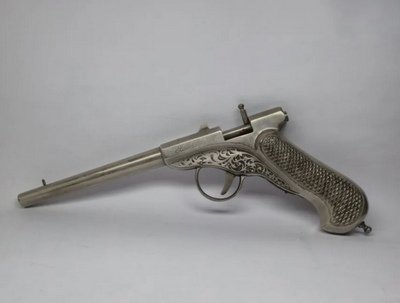
I was at 89 College Road, either because Mercury had delivered a message or it was one of Auntie Florrie’s famous tea parties or I was there helping with something. I think most likely the latter. Auntie Florrie said something like: “come along with me and she and I went into her bedroom – which was at the front of her bungalow on the left of the hall as you entered the front door. She then pulled out the drawer of her bedside cupboard and pulled out a heavy looking all metal pistol! It was plated a dull silver colour, not dark metallic gunmetal, which immediately marked it as unusual in my teenage eyes. It was also unusual in that it had a grip or pull under the butt. It was elegant rather than menacing – more like an old-fashioned dueling pistol than a modern automatic or revolver. Auntie Florrie handed it to me and it was remarkably heavy in my hand. It weighed about one and a half pounds. The body of the pistol was cast in one piece – nickel plated cast iron, with a barrel length of about 9 inches and a needle sight at the muzzle.
Auntie Florrie explained that she kept this pistol by her bed to threaten any burglar that got past her deterrence of the door protecting Kudu horns. She didn’t tell me how she had acquired the weapon – I am guessing that one of her brothers had given it to her. There again, Auntie Florrie was quite capable of acquiring something like this of her own volition. Either she explained that it was an air pistol or I discovered this for myself. The grip/pull under the butt pulled out against a strong spring and engaged with the trigger mechanism and when you pulled the trigger it released a plunger driving air from the chamber in the butt through the pellet chamber discharging any pellet out of the barrel. A most inefficient method of firing a pellet as I soon discovered.
It quickly became apparent that Auntie Florrie was making a present of this pistol to me and with alacrity I accepted. At the age of 13 or 14 one doesn’t ask inhibiting questions such as Why me? Why now as it is not my birthday? Or but what will you do when a burglar does get through the deterrence of the Kudu? I just counted my good fortune and carried away my trophy – probably in the saddlebag of my Hawk-de-luxe!
The weapon came with no ammunition or instructions, but it was fairly obvious how it worked. One simply pulled down the grip at the base of the butt; the trigger mechanism locked the plunger. The bolt was slid back to reveal the chamber for the dart or slug, the bolt re-engaged and the gun aimed, the trigger pulled. I discovered very quickly that it was a .177 calibre, smooth barreled pistol and was remarkably inefficient design (not that I told Auntie Florrie this) as the air, drawn into the compression chamber within the pistol butt travelled through an angled tube through a rather loose-fitting bolt until it met the dart or slug and so drove this through the nine inches or so of barrel.
Nevertheless, it was a gun, a rather antique looking, nickel-plated gun – as opposed to the modern gunmetal air pistols of my friends. And needless to say, I certainly didn’t tell my parents – or even my siblings as I was sure that if it became known that I was acquiring an armoury then such a weapon would have been returned post haste to Auntie Florrie
The pistol must have been hidden away in Invicta, not from our parents who I do not recall prying or inquiring over much into our lives – we were very much left to our own devices and trusted to do so. It was the risk of my siblings finding and using the weapon that was my concern. So, I remember hiding the loading handle and my small stock of darts and pellets in a separate place from the pistol – as I later learnt from Ben, my soldier son. A principle of security that weapons and ammunition are stored separately under separate authority. Apart from wartime.
The next step was to find out what I could about my new acquisition.
As members of Sittingbourne public library, all of us children were experienced researchers and great botherers of public relations departments of companies, so I both visited the library and wrote to the only airgun manufacturer that I knew – the Diana company of the UK. Both approaches revealed nothing at all. It was only some sixty years later that internet searches provided me with the information that the air pistol was of German manufacture. Apparently, it was a “Eisenwerke Gaggenau MF luftpistole” (air pistol)
made by Michael Flürscheim, at his factory: Eisenwerke Gaggenau in the district of Baden-Wurttemberg, Germany between 1878 and 1900 and was the first air pistol of German design and manufacture.
How much it is worth and how it came into Auntie Florrie’s ownership are both unknown. First, it is not for sale and it is one of my treasures, because it looks rather fine (these pistols have been described by collectors as one of the most elegant of air pistols ever made) and more importantly – it reminds me of that far off day in Auntie Florrie’s house she chose to give me this fine weapon and obviously trusted me sufficiently to know that I would not use it to terrorise my siblings or shoot dangerously.
…………………………………………………………………………………………………………………………………………………………
5.
Auntie Florrie and the Battle of the Atlantic
As you know Best Beloved, trips with Auntie Florrie were not just local shopping or even just trips to local museums or libraries – as one might expect from a great aunt who was a teacher by profession. There must have been at least one trip to London, and possibly more. Only one aspect of this particular trip to London sticks in my mind and this is the subject of this story. Why we were in London, what the purpose was, how old I was is all lost in the mists of my memory. But the topic itself is sharp and clear. This is how it fell out…
I was in London with Auntie Florrie and my brother Terry and we were at Victoria Station en route for home. The time was in the afternoon and we were returning to Sittingbourne by train – which is why we were at Victoria. On arrival at the station, apparently our train was cancelled. Though I think now that it was not just one train but there must have been a more significant delay. So, we came away from the platform and I assumed that we would just sit on a station bench and wait for our train. But to my amazement and delight, Auntie Florrie announced that we would kill the time by going to see a film. – in the afternoon too. Films you must remember O Best Beloved in those days were only shown in the evenings or in the mornings at Children’s Cinema (6d. at the Queens). So, Auntie Florrie took us off to platform 19 where there was an Art Deco entrance. We went up the stairs and there, tucked away under the station roof above the platform in a sort of corner of the station was a small but fully functioning cinema. The film being shown was the film adaptation of Nicholas Monsarrat’s “The Cruel Sea”. Tickets were purchased and in we went. I can only remember some clips of the film – my memories are overladen by more recent viewing as an adult – but I can clearly remember the sea, the corvette (even then I was interested in the Royal Navy) and the gravelly voiced Jack Hawkins as the commander of HMS Compass Rose – the real hero of the film. But above all I recall the sheer adventure of going to a war film during the daytime and how our cosmopolitan great aunt knew that there was a cinema tucked away in the roof of Victoria Station.
……………………………………………………………………………………………………………………………………………………………
6
Auntie Florrie and Bismark
Every Friday evening Auntie Florrie would walk down from her bungalow in College Road and spend the evening playing cards with her sister, our grandmother who had a bed sitting room just off the hall. Grandma had a proper green baize covered square card table that folded away when not in use. They would set the card table up just in front of the fire – which was in the corner of the room, or in summer time set the table up by the window which looked out onto the garden.
We children were never part of this evening of card games and so I have no idea of what games they played. However, I do have in my possession one of the packs of cards that were grandma’s, complete with its homemade Rexine sleeve that she must have made to hold the cards and a scoring pad and a pencil.
While we children were never part of these Friday evening sisters’ card games, Auntie Florrie saw to it that we were all taught how to play cards. Like Grandma, Auntie Florrie had her own green baize card table at her bungalow in College Road and it was around this that we were taught cards. She taught us the standard games such as whist and rummy but she also taught us rather arcane Edwardian games with intriguing names such as Bismark and Bezique. These games were complex and fascinating. Learning them felt like the induction rites to a secret society as we could only play these games with each other or with Auntie Florrie – and maybe Grandma, as none of my friends had even heard of these games, let alone knew the rules or were willing to learn them.
Bismark is the one game I best recall – probably because I both enjoyed it and also, it reminded me of the German battleship that had been sunk by the Home Fleet in 1941. As I recall it, this game was a form of whist but only required 3 players. There were four rounds: No Trumps, Spades, Dealers choice of Trumps and Misère. This last round fascinated me as the aim in this round was to lose the tricks – and was played without trumps. The other obscure or arcane games we played were: Napoleon or Nap which required gambling with the highly polished stones that Auntie Florrie kept in a tin for this purpose (and for Put & Take -played with a beautiful heavy brass spinner). Also, Quinto, which required playing with a partner and had a sort of built in hierarchy of trumps with hearts leading. I also recall that the Joker was added into the pack, but can’t remember its role. Looking back on these card games, I think that I see the hand (pardon the pun) of the teacher as playing these games taught, teamwork, arithmetic, memory, and following set rules.
…………………………………………………………………………………………………………………………………………………..
7.
UNCLE CHARLIE, AUNTIE FLORRIE AND THE CROCODILE
This story, O Best Beloved, is very well known and regularly retold among the Barry Clan, it is also bound to have been written down by Auntie Florrie herself and included in the compilations of her stories, that are treasured among us. However, I am going to retell it from memory without reference to the earlier manuscripts and instead rely on oral tradition and leave it to you; gentle reader, to see if my recollection is similar to yours and to any researcher (in the Opie tradition), to check my story against other sources.
This then is what I remember from the telling by Auntie Florrie – regrettably without the storyteller’s pitch and voice, somewhat theatrical but basically entertaining for small and biddable children.
“Great Uncle Charlie was working in Africa and one day while he was in his camp, a group of men, the elders, from a nearby village came to his tent and requested an interview. Uncle Charlie was sitting outside his tent in a camp stool and the men, with considerable emotion explained that their village nearby was on the banks of a river and that a great crocodile lurked in the river. Several small children while going to the river to fetch water, had been ambushed by this great beast and eaten them. Now the whole village, even the adult men, would not go to the nearby river to fetch water or to fish but instead had to walk miles for an alternative source of drinking water. These elders implored Uncle Charlie to shoot and kill this crocodile for them.
Uncle Charlie agreed to carry out this task for the villagers and took his rifle and a piece of meat (or was it a dead Kudu?) down to the spot on the river bank where the villagers said this monstrous beast might be found. He hung the meat/dead Kudu by a piece of rope from a nearby tree, then positioned himself lying prone and hidden back from the river, with his rifle at the ready and pointing towards the bait. Before long his vigil was rewarded as a huge crocodile came slowly out of the river and stalked up the bank. As this great reptile reached up to seize the bait, Uncle Charlie took careful aim and pulled the trigger. He fired right at the crocodile but to his horror, the great beast gave a huge leap forwards towards where Uncle Charlie lay hidden. He jumped up and fled, dropping his rifle as he made his escape. He made his way back to his camp, somewhat unnerved but pleased not to have suffered the same fate as the village children.
Sometime later, a procession of the villagers appeared – bearing with them a huge box of butter as a thank you gift! Apparently, the crocodile was not attacking him when it jumped up but was in its death leap. The villagers told him that the reptile was dead but had fallen on his rifle and broken it but they insisted he accepted the gift of the butter for ridding them of this monster.
Postscript
Was this a true story? Has it been embellished by Auntie Florrie to entertain us children? Certainly, her brother Charlie lived and worked in Tanganyika. He also worked “up country” but whether he carried a rifle while surveying the line for the telegraph is unknown. Two interesting elements in this story are the odd gift that the villagers gave to Uncle Charlie and the fact that the story presents him as less than courageous – and only he could have told this story. Both these pieces of evidence would appear to suggest that there might well be some truth in this story.
…………………………………………………………………………………………………………………………………………………………….
8.
Auntie Florrie and the red yacht
My very earliest memories of Auntie Florrie, Oh Best Beloved, date from well before she came to live in Sittingbourne and therefore long before I was promoted to be a messenger from the gods. Perhaps I was five or six, so in about 1955 or 56 we went to stay with Auntie Florrie. I say ‘we’ but I cannot remember who else was in the party. Were we all there? – Terry, me, Ding and Maggie with Mum and Dad or was it just a selection? I think that I can remember Dad – maybe it was just Dad and I – Perhaps I was being treated to make up for Terry seizing my role at my birthday party at the Old Wheel when I was ill with measles…….
Anyhow we were taken to London to stay with Auntie Florrie and I remember sleeping in a room high up in her house in South Dean Gardens.
My earliest memory of Auntie Florrie dates from well before she came to live in Sittingbourne and well before I was promoted to the winged messenger of the gods. My memories are fragmentary but those that I have are quite sharp and bright.
Sleeping (alone) in a single bed high up in a bedroom in her house in South Dean Gardens in Wimbledon. I was clearly there ‘on holiday’ Her house had a small garden and I recall Auntie Florrie taking me down into the garden and showed me, much to my delight, a small pond – made out of a recycled white porcelain sink, in which was floating a small red plastic yacht with a white sail. This she said was my yacht and my pool (so maybe I was the only child of the family there?). On my bedside cabinet was a brand-new glossy postcard of a life guard. It seemed awfully big to me and tremendously new and shiny. A real treasure – and once again most definitely mine and I recall taking it home with me as a treasure from this holiday.
In those days the red London double decker buses had an open platform at the back where the stairs led to the upper deck. It was not uncommon for passengers to jump on and off the bus via this platform when it was standing in traffic, or even moving. When not collecting fares and issuing tickets, the bus conductor stood here. Just inside from this platform were two four-seater bench seats, facing each other across the aisle (over the wheel arch). Dad and I were sitting on these seats, when for some unaccountable reason while the bus was zooming along, I decided to get up from my seat and step off the platform. I remember dad being astonished and shocked and leaping up to grab me but it was the quicker bus conductor who grabbed hold of me and handed me back to Dad.
What Auntie Florrie had to say about this is neither recalled nor recorded by this scribe.
…………………………………………………………………………………………………………………………………………………………..
9.
Auntie Tusitala, The House of treasures and Kim’s Game
Not only did Auntie Florrie give me a nickname but she also had one for herself: “Auntie Tusitala”. This is a Samoan term which translates to “teller of tales or “storyteller”. This term famously became the nickname of the Scottish author Robert Louis Stevenson (author of Treasure Island and many other tales) when he moved to the South Seas in the late 1880’s to recover his health. It was an appropriate name for him and a most appropriate nickname for Auntie Florrie for she had a great gift in storytelling. Her life as a daughter of the Regiment, the activities of her brothers, the richness of experience of her life combined with her teaching and presentation skills, made her a theatrical and entertaining story teller. She also had a gift as a writer and was able to write these stories down in an entertaining and informative way. She obviously saw it as her role as “Great Aunt Florenz” that as well as feeding us with tea, homemade cake and homemade fudge, that she should entertain us with her stories after tea. As a boy and young teenager, I was enthralled by these stories and delighted in these tales and the telling of them. Sitting on her sofa, replete after tea and cake, these stories were an integral part of tea with Auntie Florrie.
Her bungalow at 89 College Road was indeed stuffed full of the treasure of the Empire. This was probably common among her generation who either had lived and worked abroad administering or soldiering in the empire and had collected various items on their travels. I recall a bronze scorpion, a fez taken from a Turkish soldier at the fall of Jerusalem, a shako of the 17th Lancers, a French fin siècle music alarm clock, a leopard skin and a Maasai Assegai, to say nothing of the Kudu horns that guarded the front door.
Auntie Florrie was a great believer in parlour games and we children were enthusiastic participants in these games. All of them were fun but looking back, I see now that they were also educational and each of them taught one or more skills. It was at College Road that I first came across Kim’s Game – the memory game involving a tray of 25 small items and a cloth – and one’s brain! There was also Consequences, The floating needle, I went to Market and Put and Take. The last had no educational value but was great fun and for this Auntie Florrie produced a tin full of highly polished semi-precious stones and a heavy brass spinner -Take 1; Put 1, Take 6, Put 3 etc etc
Even now after 65 years I can still recall those afternoons and evenings. Strong tea poured from a Willow Pattern teapot into Willow Pattern cups, the taste of homemade jam and homemade cake and her wonderful fudge. Auntie Florrie brought a deal of richness into our lives. We appreciated it then and we honour her memory now.